McAllister Wood Products
Local hardwood slabs, custom-cut lumber, mulch, firewood, and specialty wood products.

Local hardwood slabs, custom-cut lumber, mulch, firewood, and specialty wood products.
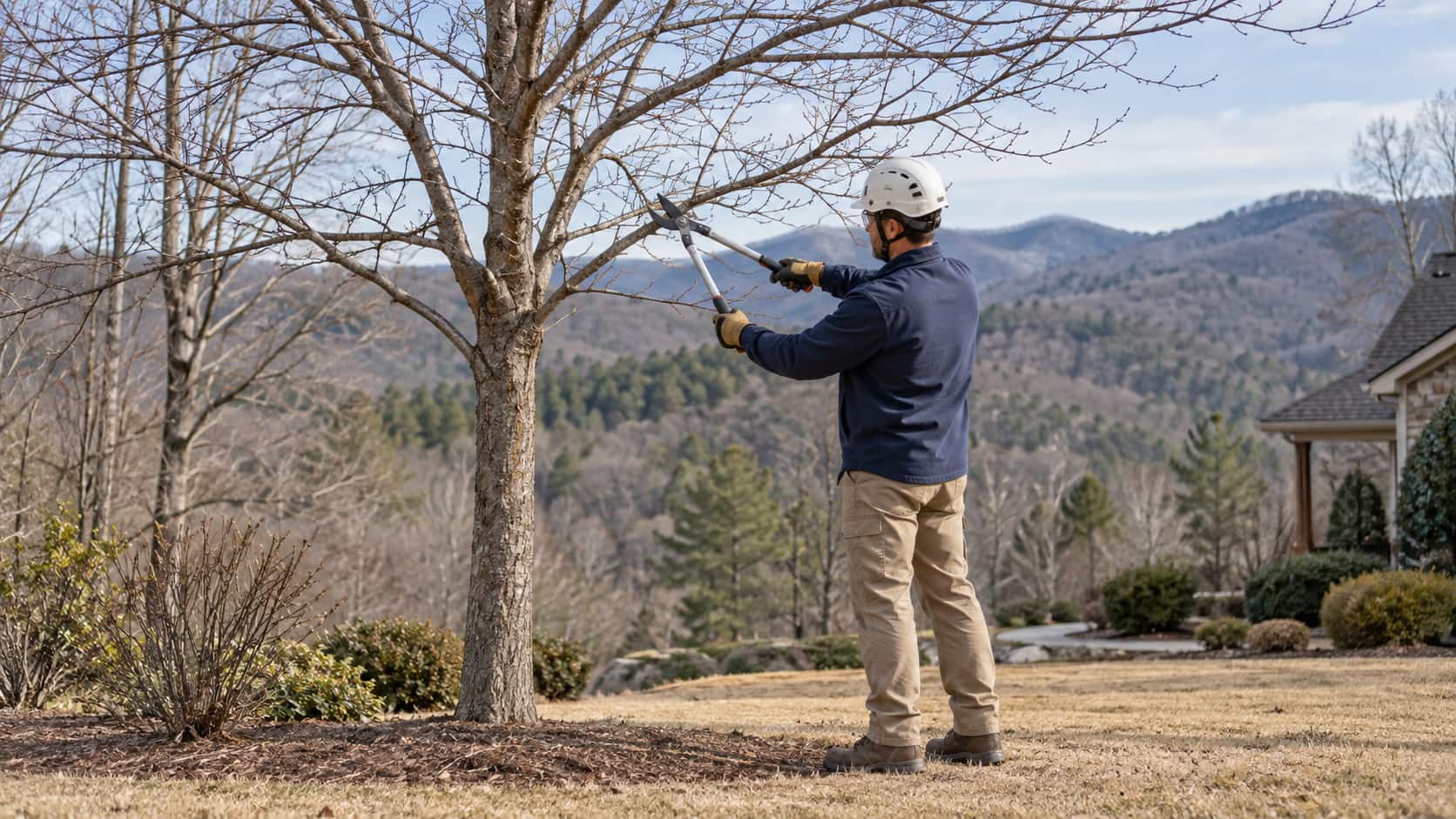
Late winter is the default, but flowering trees, oaks, and elevation all change the answer. A practical pruning calendar for mountain and Piedmont properties.
The short answer for most shade trees in our region is late winter, from roughly late January through early March, before buds swell. The longer answer depends on what kind of tree it is, what you want the pruning to accomplish, and whether the tree is standing at 900 feet near a lake or at 3,500 feet on a north-facing slope. Those two properties can be three or four weeks apart on the calendar.
This article lays out the general timing, the exceptions that matter most in the Southern Appalachians and upper Piedmont, and the kinds of pruning that should not wait for a season.
Trees handle pruning best when they are not actively growing. From leaf drop until buds break in spring, a tree’s energy is stored in the roots and trunk rather than in the canopy, so removing branches costs it less. Without leaves, the branch structure is visible, which makes it easier to see crossing limbs, weak unions, and the overall shape. Insects and fungal spores that can enter fresh cuts are far less active in cold weather. And when growth resumes in spring, the tree closes the wounds relatively quickly.
The Georgia Forestry Commission’s seasonal guidance makes the same point from the other direction: keep summer pruning light, and save major structural work for winter when trees are dormant and branch arrangement is easier to read.
There is a window in October and November that looks like dormant season and is not quite. A tree that still has leaves, or has only just dropped them, may still respond to a large pruning cut by pushing new growth. That growth has no time to harden before the first hard freeze and is often killed back, which wastes the tree’s reserves and leaves dead tips.
Clemson Extension’s guidance on pruning trees advises against pruning within about ten weeks of your area’s first hard frost for this reason. In the mountains, where first frost can arrive in mid-October, that pushes the safe fall window back into early August, which is really the summer window. In the Piedmont, where frost often holds off until early November, the same rule still rules out most of the fall.
The practical takeaway: fall is for removing dead wood and clear hazards, not for shaping a healthy tree.
Most oaks, hickories, maples, poplars, and pines can be pruned in late winter without much concern. A few groups need different timing.
Spring-flowering trees. Dogwood, redbud, serviceberry, flowering cherry, and saucer magnolia set their flower buds the previous summer. Prune them in winter and you cut off the spring show. Clemson’s rule of thumb is that trees which flower before June 1 should be pruned right after they finish blooming. Crape myrtle and other summer bloomers flower on new growth, so late winter is fine for them.
Maples, birches, and other heavy bleeders. These species run sap freely from cuts made in late winter and early spring. The bleeding is mostly cosmetic and does not seriously harm the tree, but if the look bothers you, pruning them in early summer after the leaves have fully expanded avoids it.
Oaks and oak wilt. Oak wilt is a serious disease spread partly by beetles attracted to fresh wounds during the growing season. It is not established in our region the way it is in Texas and the Midwest, but the Tennessee Division of Forestry notes it has been detected there in the past. Keeping oak pruning to the dormant season is a low-cost precaution.
Fruit trees. Apples and pears are typically pruned in late winter before growth begins, with light summer pruning for water sprouts and disease removal. Peaches are handled differently and are usually pruned closer to bloom time. If you have a small orchard, that is a subject of its own.
The region’s terrain compresses a lot of climate into a short drive. A property in the lower foothills may see its trees leaf out in late March. A property above 3,000 feet may not see the same species leaf out until late April. Dormancy runs the other way in fall, arriving in the mountains first.
That shifts the pruning calendar in both directions.
If you are not sure which pattern your property follows, watch when the trees around you drop leaves and when the buds swell. Two or three years of noticing gets you most of the way.
Dead, broken, hanging, and diseased branches do not wait for a season. Removing them promptly reduces the chance of a limb coming down and, in the case of disease, can slow the spread. Storm-damaged limbs with torn bark should be cut back cleanly to a proper branch collar as soon as it is safe, because a ragged tear closes slowly and invites decay.
Limbs that are rubbing on a roof, blocking a driveway sightline, or contacting a structure also fall in the fix-it-now category, though a heavy summer removal on a stressed tree is still worth discussing with an arborist first.
The University of Georgia’s Basic Principles of Pruning Woody Plants explains why pruning stimulates regrowth: the root system is unchanged, so it pushes the same energy into fewer buds. Remove too much canopy in one season and the tree responds with a flush of weak, fast-growing sprouts. A common guideline is to stay under a quarter of the live canopy in any one year for mature trees, and less for a tree that is already stressed. Trees that came through this year’s drought fall into that second group.
The same publication is a good introduction to the difference between thinning cuts, which remove a branch back to its point of origin, and heading cuts, which shorten a branch to a stub or a small lateral. Heading cuts on large limbs are what topping is made of, and the result is the weak, decay-prone regrowth described in our storm preparation article.
Small ornamental trees and low branches you can reach from the ground with a hand saw are reasonable homeowner work in the right season. Beyond that, the calculation changes.
McAllister’s tree trimming and pruning work is scheduled with these timing considerations in mind, and the dormant season is when the calendar fills fastest. If you have a large oak, maple, or poplar that has not been looked at in a decade, or a younger tree that could use structural correction while the cuts are still small, request a quote this fall and we can plan the work for the right window.
