McAllister Wood Products
Local hardwood slabs, custom-cut lumber, mulch, firewood, and specialty wood products.

Local hardwood slabs, custom-cut lumber, mulch, firewood, and specialty wood products.
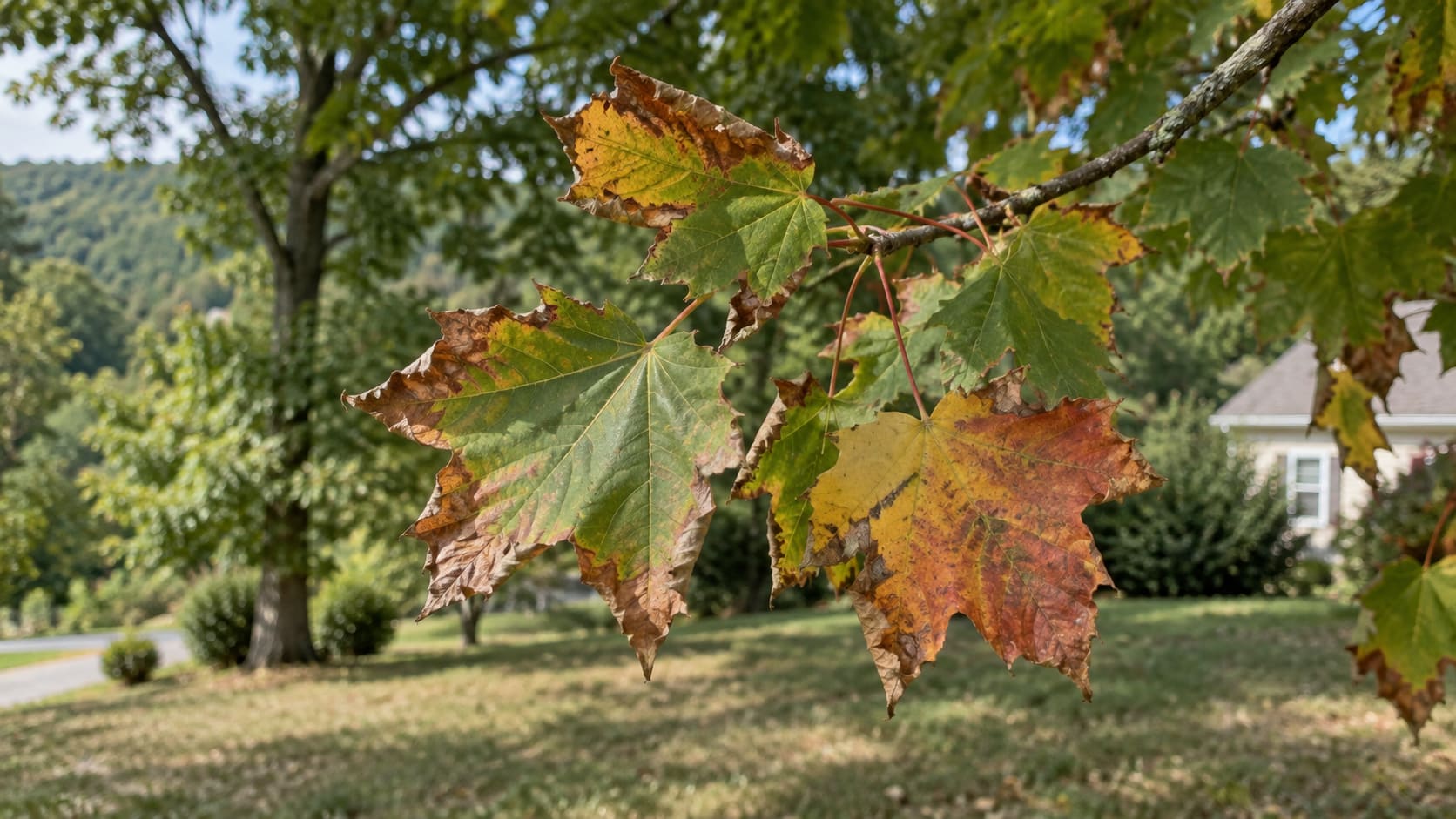
Early fall color and leaf drop are showing up across the region this year. Learn what drought stress looks like, what else it could be, and when to have a tree checked.
If a maple in your yard turned red in the last week of August, or an oak has been dropping crisp brown leaves since Labor Day, you are not imagining it. Early color and early leaf drop are showing up across the region this year, and the most common reason is the one you might guess. It has been dry.
That does not automatically mean the tree is in trouble. Trees shed leaves early for several reasons, some temporary and some not. This article walks through what you can see from the ground, what those signs tend to mean, and how to tell the difference between a tree that needs water and patience and one that needs a closer look.
Most of Northeast Georgia, Upstate South Carolina, and Western North Carolina came through a record dry stretch from last September through March. Late spring and early summer rain brought relief across much of Georgia, but drought has crept back into the northeast counties over the past several weeks. Trees that spent the spring rebuilding after a dry winter are now heading into fall short on moisture again.
Forestry researchers expect the effects to show in the leaves. NC State’s fall foliage forecast for 2026 describes drought-stressed trees shutting down early to conserve water, which makes leaves turn brown ahead of schedule and shortens the color season. The same pattern applies on our side of the state line.
Elevation changes the timing but not the mechanism. Trees above 3,000 feet normally begin turning in late September and peak in mid-October. Down in the Piedmont, peak color usually arrives closer to early November. Early stress color pushes both windows forward, so a tree at the lake that is fully red in the third week of September is about as far out of step as a mountain tree that turned in August.
Drought stress has a recognizable look, and it is worth learning because the same signs can point to other root problems.
NC State’s summary of drought stress in trees is a good reference for these symptoms and for why stressed trees are more vulnerable to insects and disease afterward.
Drought is the likely explanation this fall, but it is not the only one, and some causes deserve attention regardless of the weather.
Root disturbance. Trenching for a utility line, grading for a new driveway, a pool installation, or a neighbor’s clearing project can cut a large share of a tree’s roots. The canopy may look fine for a season or two and then decline. If a tree began turning early within a few years of construction near it, the two are worth connecting.
Compaction and pavement. Trees along driveways, next to parking areas, or in lawns that get heavy equipment traffic often show early color year after year. Roots under compacted soil get less air and water.
Trunk damage. Walk around the base. Mower and string-trimmer wounds, bark that is splitting or lifting, sunken areas, and sap or dark staining can all reduce the flow of water up the trunk.
Fungal growth or hollow sounds. Mushrooms at the root flare or on the trunk, conks on the bark, or soft wood at the base suggest internal decay. These do not cause early leaf color by themselves, but a tree showing both early color and decay signs has more than one thing going on.
Insects. Fine sawdust at the base, small holes in the bark, or bark peeling off in sheets can indicate borers, which often target trees that are already weakened by drought.
None of these can be confirmed from a leaf. They are reasons to keep looking, and in several cases, reasons to have someone look with you.
For a tree that is stressed but otherwise sound, the most useful steps are simple.
Water slowly and deeply. A sprinkler that runs fifteen minutes does little for a tree. A soaker hose or a slowly running hose left at the drip line for an hour or two once a week during dry spells does far more. Established trees rarely need this, but a tree that is showing scorch in a drought year is telling you it does. Check local watering restrictions first; some areas of the region have been under drought response rules this year.
Mulch, but not against the trunk. Two to three inches of wood chips or shredded bark from the drip line inward, kept several inches away from the trunk, holds moisture and moderates soil temperature. A mulch volcano piled against the bark does the opposite.
Hold off on fertilizer. Pushing new growth on a tree that cannot support the leaves it has adds stress. Fall fertilization can make sense for some trees, but that decision is better made after the tree is assessed.
Do not prune living branches now. Removing green wood in late summer or early fall removes the tree’s remaining ability to make and store energy. Dead branches can come out any time.
Take photos. A picture of the tree now and another in late spring will tell you more about the trend than memory will.
Early fall color alone, in a drought year, is usually a reason to water and watch. A few combinations move it up the list.
An arborist assessment looks at the whole picture: the crown, the trunk, the root flare, the soil, and what is around the tree. The recommendation may be as simple as a watering plan and a follow-up visit next summer. It may be structural pruning, or, for a tree that has declined too far, planning for removal before winter storms decide the timing for you.
If you are seeing early color on a tree you care about and are not sure what it means, tell us what you are noticing and send a few photos. We can help you figure out whether it needs water, time, or a visit.
