McAllister Wood Products
Local hardwood slabs, custom-cut lumber, mulch, firewood, and specialty wood products.

Local hardwood slabs, custom-cut lumber, mulch, firewood, and specialty wood products.
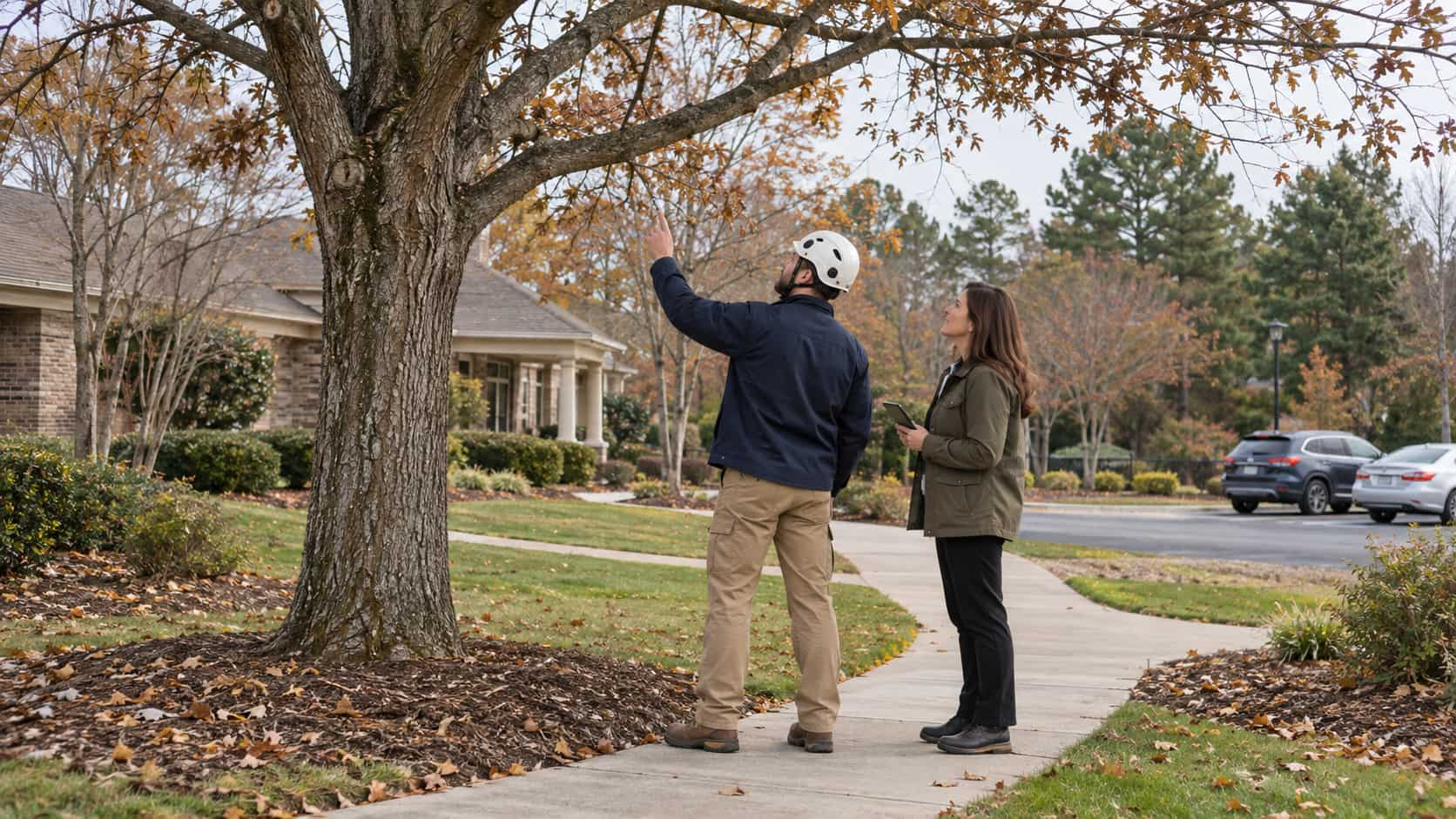
A practical fall walk-through for property managers and HOA boards: what to look at, what to record, which trees fail under ice, and how to budget the work.
For a property manager or an HOA board, trees are an asset that mostly takes care of itself until it does not. The moment it stops is usually a February ice storm, a limb on a resident’s car, or a sidewalk heaved by roots that someone finally trips over. Each of those becomes a claim, a complaint, or an emergency invoice, and each is easier to handle if the property already has a simple routine for looking at its trees.
Fall is the right time to build that routine. Leaves are still on, so dead limbs stand out. Budgets for next year are being set. And winter weather in the mountains and foothills, where wet snow and ice add a load that summer storms never do, is a few months out. Here is a practical way to walk a property before winter, what to record, and how to turn the walk into a plan the board can approve.
A homeowner with six trees can keep track of them in their head. A subdivision with two hundred street trees, a retail center with a landscaped parking lot, or a church campus with a grove of mature oaks cannot. The stakes are different too. These trees stand over sidewalks, parking spaces, playgrounds, and entrances where people are present all day, which is what arborists mean when they talk about targets.
There is also a documentation question. A property owner who can show that trees were inspected on a schedule and that identified problems were addressed is in a very different position after an incident than one who cannot. The International Society of Arboriculture’s guide to recognizing tree risk is written for tree owners and puts it plainly: it is the owner’s responsibility to ensure the safety of others around trees on the property, and regular care by a qualified arborist is how defects get found before they become incidents.
A pre-winter walk does not need to be a formal risk assessment. It is a way to sort the property’s trees into three groups: fine for now, worth watching, and needs a professional look. Bring a printed site map, a phone for photos, and someone from the landscape or maintenance side if you have one.
Start with the high-traffic areas. Entrances, sidewalks, mailbox clusters, playgrounds, pool decks, bus stops, and the rows of parking closest to the building. A defect on a tree here matters more than the same defect at the back of a retention pond.
Look up first. Dead limbs, broken limbs hung in the canopy, and limbs that have grown out over roofs, light poles, or parking spaces. In fall, dead wood is obvious because it has no leaves while the rest of the tree still does.
Then the trunk and unions. Cracks, cavities, missing bark, and places where two large stems meet in a tight V with a seam running down from the junction. Those unions are where ice load does its damage.
Then the base. Mushrooms or shelf fungi at the root flare, soil lifting on one side, exposed or cut roots, and any lean that looks new. Also note roots that are lifting sidewalk panels or curbs, since those are both a trip hazard and a sign the tree is short on rooting space.
Then the history. Any construction, trenching, repaving, or grading near a tree in the past few years. Root damage from that kind of work often shows in the canopy two to five years later.
Our article on warning signs that a tree may fall goes deeper on what each of these defects can mean and which ones are emergencies.
For each tree that lands in the watch or needs-a-look group, note the following. It takes about a minute per tree.
Two things this list does not include are a risk rating and a recommendation. Those belong to a qualified arborist, and a board record that assigns “high risk” to a tree without professional backing can create as many problems as it solves.
Most of Northeast Georgia and the Carolina foothills see at least one ice event in a typical winter, and properties above 2,500 feet see several. Ice and wet snow load trees in a way that wind does not. The weight accumulates on every twig, and trees with dense canopies, weak unions, or long horizontal limbs are the ones that come apart.
A few groups deserve extra attention on the fall walk.
Ice also brings down limbs onto lines. Any tree growing into the service drops or distribution lines that serve the property should be on the list, and clearance work near energized lines is a job for the utility or a line-clearance qualified crew, never general maintenance staff.
Once the walk is done, the list of watch and needs-a-look trees becomes the scope for an arborist visit. For a property with more than a handful of flagged trees, a structured evaluation makes sense: which trees are immediate hazards, which need pruning, which should be removed, which should be monitored, and where the root conflicts with sidewalks and curbs are. That gives the board or ownership a prioritized list rather than a series of one-off decisions.
From there, the work splits into three buckets for budgeting.
Property managers also need the paperwork side handled: certificates of insurance, a written scope, site controls during the work, and cleanup expectations. McAllister’s commercial tree services are set up for that. Insurance documentation can be provided before scheduling, and the agreed scope and cleanup are confirmed in advance and reviewed after.
Even a well-managed property will have damage after a significant ice event. The same walk works in reverse: check the high-traffic areas first, keep people away from hanging limbs and anything touching a line, photograph damage from a safe distance, and call for emergency tree service for trees on structures or blocking access. Non-urgent cleanup can be scheduled once the immediate hazards are handled.
If you manage a property in the region and have not had its trees looked at in a few years, this fall is the time to do the walk and get the flagged trees evaluated. Our commercial tree services page explains how McAllister works with HOAs, property managers, and businesses on assessments, scheduled maintenance, and storm response.
