McAllister Wood Products
Local hardwood slabs, custom-cut lumber, mulch, firewood, and specialty wood products.

Local hardwood slabs, custom-cut lumber, mulch, firewood, and specialty wood products.
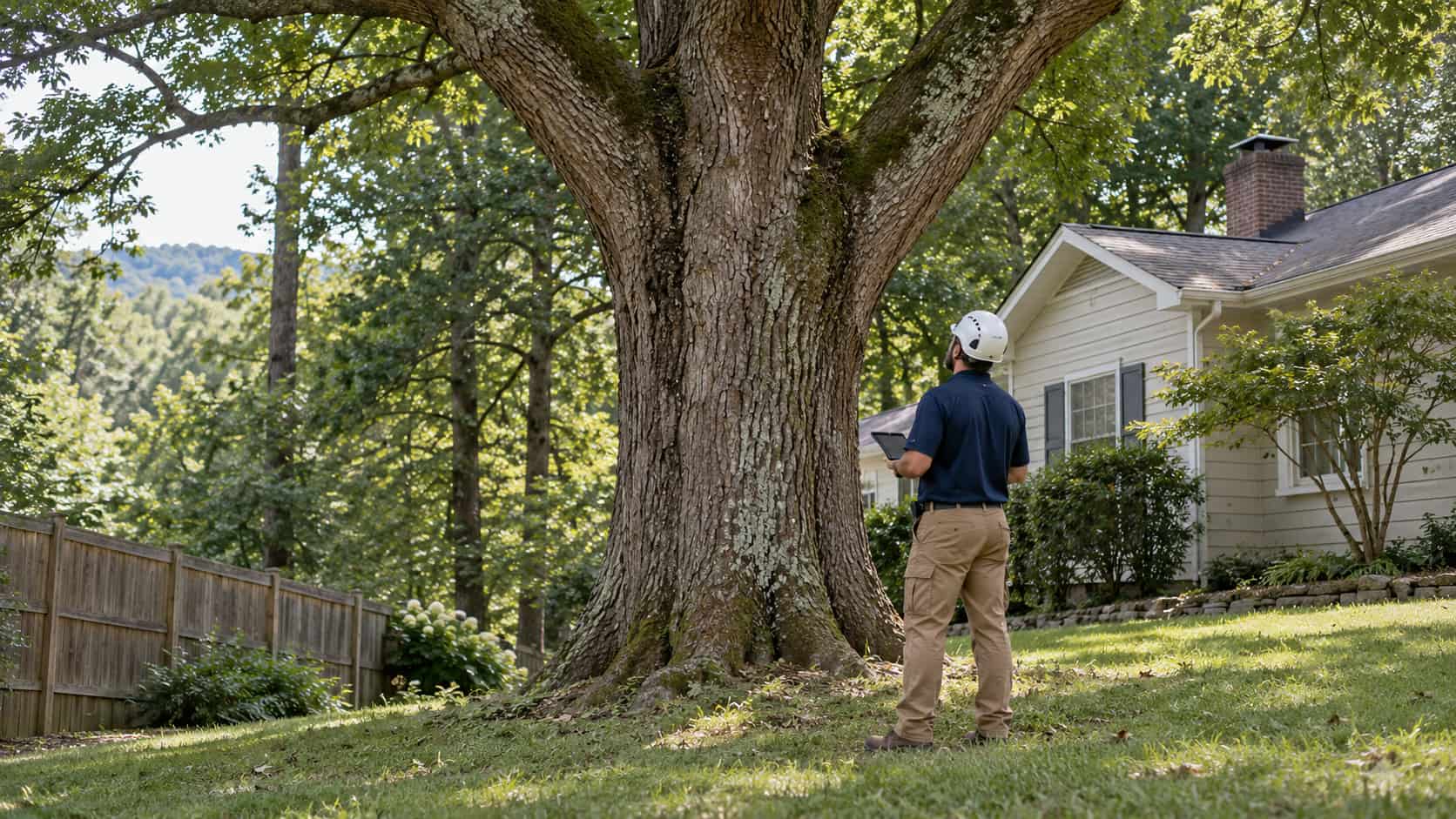
Size, condition, what the tree could hit, access, wood handling, and timing all set the price of a removal. What an estimate is really pricing and how to compare quotes.
The first question most people have about taking down a tree is what it will cost, and the short answer is that it depends on the tree and the spot it is standing in far more than on the company you call. Two oaks of the same size can be very different jobs. One stands in an open side yard with a truck path to it. The other leans over a roof, has a shed on one side and a septic field on the other, and can only be reached through a gate the width of a wheelbarrow.
This article explains what a tree crew is actually looking at when they price a removal, why quotes for what seem like similar trees can be far apart, and how to get a quote that reflects your situation rather than a guess.
A removal price is mostly a labor and equipment estimate. The crew is answering three questions: how long will this take, how many people and what equipment will it need, and what could go wrong. Everything below feeds into those three.
Height and trunk diameter set the baseline. A taller tree means more climbing or more crane time, more sections to lower, and more wood on the ground afterward. Diameter affects how the trunk has to be cut and moved, and how much stump is left.
Species matters for two reasons. Some woods are heavier and denser than others, which changes rigging loads and hauling. And some species are simply more work: a big sweetgum or poplar has lots of limbs and a lot of brush to chip, while a straight pine of the same height might be a much simpler take-down.
A healthy tree can be climbed and rigged in a predictable way. A dead, decayed, or storm-damaged tree often cannot. Wood that has been dead for a year or more loses strength and can fail under a climber’s weight or when a rope loads it. Beetle-killed pines, hollow hardwoods, and trees with cracked trunks or split unions frequently have to be taken down from a bucket truck or a crane instead, and each section handled more carefully. That is slower and needs more equipment, so it costs more. Waiting until a tree is fully dead before removing it usually makes the job more expensive, not less.
This is the factor that surprises people most. A tree that can simply be felled into an open area is a fraction of the work of one that has to be dismantled piece by piece because a house, garage, fence, pool, deck, driveway, or power line is inside its fall zone. Every section that cannot be dropped has to be rigged and lowered, and every one adds time.
Overhead utility lines are their own category. Work near energized lines has to be coordinated with the utility, and some situations require the utility’s own line-clearance crews before a tree company can start.
The crew needs to get equipment to the tree and debris away from it. A wide, flat lot with a driveway next to the tree is ideal. A backyard behind a narrow gate means smaller equipment or hand-carrying brush. A steep lot, which is most lots in the mountain counties, changes how logs are moved and where trucks can park. Wet ground after a storm can keep heavy equipment off a lawn entirely.
If a crane is the safest option and the only place to set it is the street, that may involve traffic control or a permit, which also affects cost.
Chipping limbs and hauling everything away is the default for most residential jobs and takes the most labor. Leaving logs cut to length on site for firewood, or leaving chips for the homeowner to spread, reduces hauling and can lower the price. Some sound hardwood can be milled rather than chipped, and that is worth asking about on a large oak or walnut.
Grinding the stump is a separate step with its own equipment and is not automatically part of a removal quote. If you want it done, say so when you ask for the estimate so the quote covers it. The stump grinding page covers what the work involves and what the ground looks like afterward.
A tree on a house at midnight after a storm is priced differently from the same tree removed on a scheduled weekday. Emergency work means crews called in off schedule, often in bad conditions, with the added complexity of a tree resting on a damaged structure. Scheduled removals, especially in the slower dormant months, are the most economical way to take down a tree you already know needs to go.
Assuming both companies looked at the same tree, big gaps in price usually come from one of three places.
Different scope. One quote includes stump grinding, hauling, and cleanup; the other leaves logs and chips on site. Ask exactly what is included before comparing numbers.
Different method. One company plans to climb and rig; the other plans a crane. The crane quote is often higher but may be safer and faster on a tree over a house, and it can be the only reasonable method on a dead or decayed tree.
Different risk tolerance. A quote that is far below the others on a difficult tree is worth a hard look. Insurance, training, and proper equipment cost money, and a crew skipping them is passing the risk to you. Ask for a certificate of insurance. A legitimate tree company will send one without hesitation.
The more the estimator knows before the visit, the more accurate the quote and the fewer surprises on the day.
Every removal we quote starts with an evaluation of the tree’s condition, the access, and the hazards, and the estimate spells out what is included. If you have a tree you are considering taking down, request a quote with those photos and details and we will give you a clear number for your situation, not a range pulled from a chart.
