McAllister Wood Products
Local hardwood slabs, custom-cut lumber, mulch, firewood, and specialty wood products.

Local hardwood slabs, custom-cut lumber, mulch, firewood, and specialty wood products.
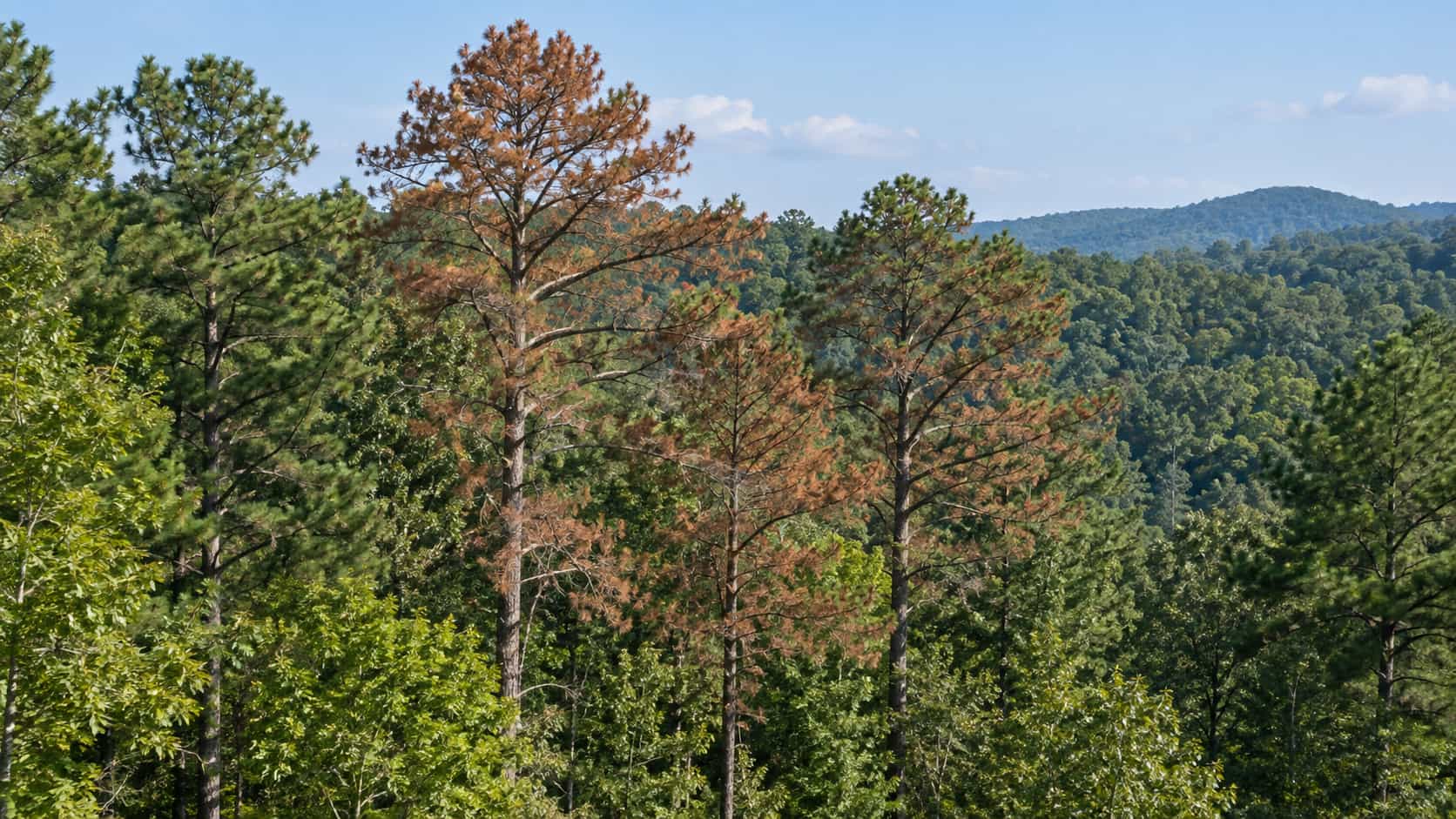
Storm damage and two dry seasons have pines fading across Northeast Georgia and the Carolinas. How to spot bark beetle attacks early and what removal timing does for neighboring trees.
A pine that was green in June and is rust-red by early September almost always has bark beetles in it. This has been a hard stretch for pines across Northeast Georgia, Upstate South Carolina, and Western North Carolina. Helene damaged timber across millions of acres of the region two years ago, a record dry winter followed, and drought has returned to the mountain counties this summer. Each of those weakens pines, and weakened pines are what bark beetles look for.
If you have pines near the house, a driveway, or a property line, here is how to recognize an attack early, what you can and cannot do about it, and why the timing of removal matters more than usual with these insects.
Georgia has five native pine bark beetles, and the Georgia Forestry Commission’s overview of pine bark beetles in Georgia describes them as the most important forest insect pests in the state because of the mortality they cause during outbreaks. For homeowners, three groups matter.
Ips engraver beetles. Three species, all small, and by far the most common cause of scattered dead pines in yards and woodlots. They attack stressed, damaged, and freshly cut pines, and they build up quickly in slash, storm debris, and drought-weakened trees. Attacks often start in the top of the tree or in individual limbs and work down.
Black turpentine beetle. Larger, slower, and focused on the bottom eight feet or so of the trunk. It leaves big pitch tubes low on the tree and often attacks trees that were injured by equipment, fire, or construction. Trees can sometimes survive a light attack.
Southern pine beetle. The one that makes headlines. It attacks healthy trees as well as stressed ones, spreads from tree to tree in expanding spots, and can kill acres of pines during an outbreak. Its populations rise and fall over years, and the state monitors it with aerial surveys. Most single dead pines in a yard are not southern pine beetle, but a cluster of dying pines spreading outward deserves a closer look.
A single dying pine commonly has more than one of these species in it at the same time.
The Georgia Forestry Commission’s page on southern pine beetles lists the classic signs, and they apply to the other species as well.
The signs that matter most for a homeowner are the early ones. A pine with pitch tubes and boring dust but still-green needles is an active attack. A pine with a red crown is a dead tree that may be a source of beetles for its neighbors.
Bark beetles are always present at low levels. They become a problem when pines are stressed and when there is a lot of fresh, dying pine material for populations to build in.
Both conditions apply now. Storm-damaged pines, snapped tops, and debris piles from Helene fed beetle populations across the region in 2025. This year’s drought has left standing pines with less sap pressure to push beetles out of their bark, which is the tree’s main defense. Trees on shallow soils, on compacted or recently graded sites, on the exposed edges of cleared lots, and in crowded stands are the most vulnerable.
Lightning-struck pines are a special case. A strike often leaves a tree alive but stressed, and beetles find it within days. If a pine near the house took a strike this summer, watch it closely.
For a tree with an active attack. For Ips and southern pine beetle, the plain answer from UGA Extension and the Georgia Forestry Commission is that once the beetles and the blue-stain fungus they carry are inside, the tree is rarely saveable. Insecticide sprays are generally not recommended for southern pine beetle, and by the time symptoms are visible, treatment for Ips is usually too late. Black turpentine beetle is the exception; a light attack low on the trunk of an otherwise healthy tree can sometimes be stopped with a properly applied insecticide, which is a licensed applicator’s job.
For neighboring pines. The most useful thing you can do is remove infested trees promptly and get the material off the property or chipped. A dead pine left standing or a fresh log pile left near healthy trees is a beetle nursery. Timing matters: removing an actively infested tree while beetles are still inside takes them with it. Removing it after they have emerged does nothing for the neighbors.
For pines you want to keep. Water deeply during drought, keep equipment and construction off the root zone, avoid wounding trunks, and thin crowded stands so the remaining trees have room. None of this guarantees anything, but a vigorous pine defends itself far better than a stressed one.
Do not stack fresh pine logs or slash next to healthy pines, and do not top or heavily prune pines during beetle season. Fresh cuts and fresh wood are attractants.
A single pine that has faded and is well away from anything is a removal you can schedule at your convenience, though sooner is better for the neighbors. A dead or dying pine within reach of the house, a driveway, a road, or a power line is a different matter. Beetle-killed pines dry out and lose strength faster than most people expect, and a red-crowned pine that has stood a year is often brittle enough to break in a moderate wind.
A cluster of fading pines spreading outward from a center point is worth a call to your county Georgia Forestry Commission office or Extension agent for identification, and to a tree service for a plan. If it turns out to be southern pine beetle, the standard response is to cut the infested trees plus a buffer of healthy ones around them, and that is a decision to make with professional input.
McAllister’s tree removal crews handle beetle-killed pines regularly, including dead pines in tight spots and near structures where the wood is already too brittle to climb safely. If you are not sure whether a pine is under attack or simply stressed, an arborist assessment can sort that out before you spend money on a removal that could wait, or wait on one that should not.
If you have pines fading on your property, request a quote and include photos of the whole tree, the crown, and any pitch tubes or sawdust you can see on the trunk from the ground. That gives us a good start on what is going on and how urgent it is.
