McAllister Wood Products
Local hardwood slabs, custom-cut lumber, mulch, firewood, and specialty wood products.

Local hardwood slabs, custom-cut lumber, mulch, firewood, and specialty wood products.
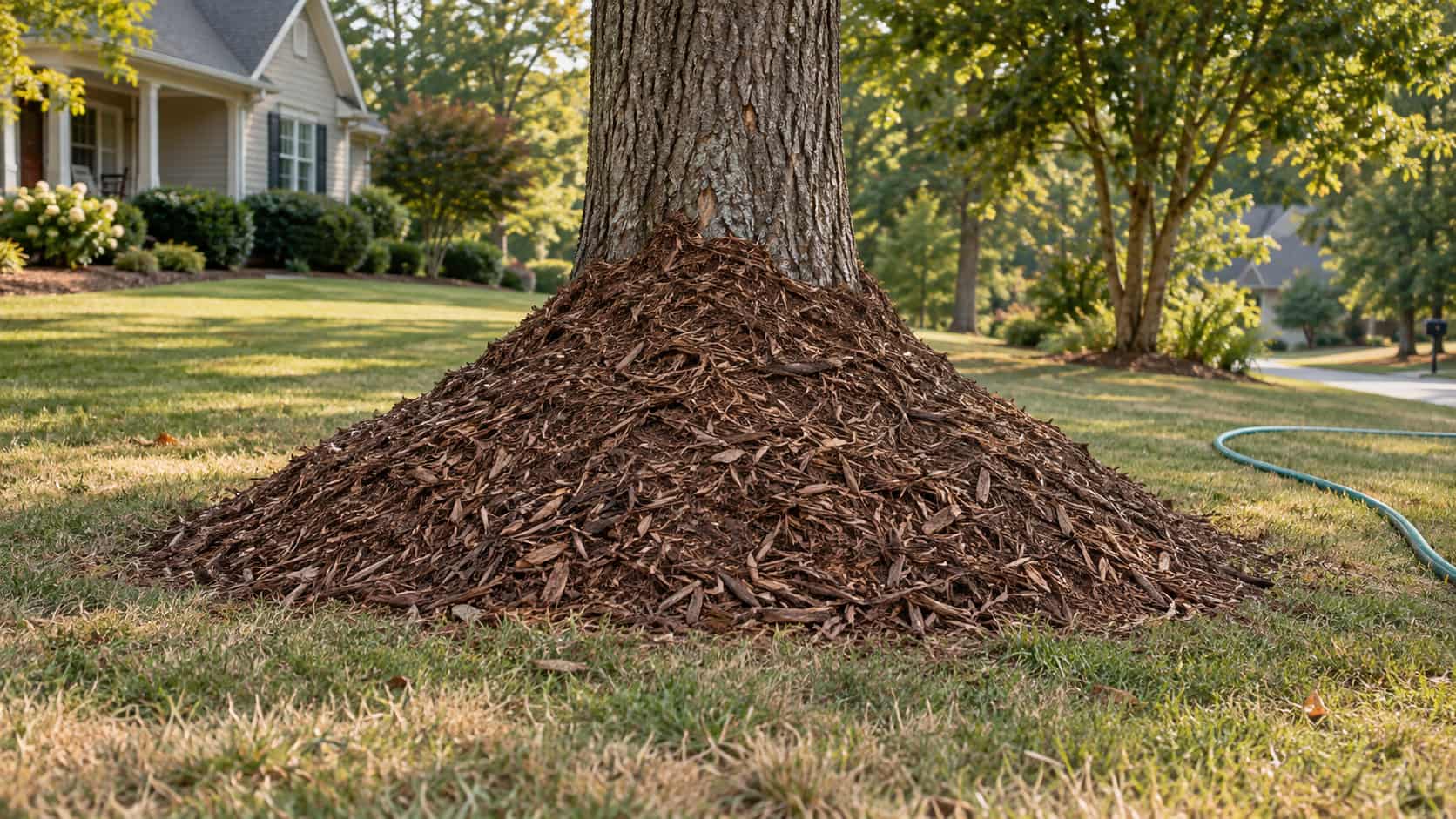
Piled mulch and shallow watering show up as stressed trees by August. Here is how deep to mulch, where the roots really are, and how to water a tree so it counts.
Late August is when trees show what kind of summer they had. After weeks of heat and spotty rain, the signs are easy to see from the driveway: scorched leaf edges, thin crowns, leaves dropping early, and in the worst cases, whole branches that have given up. Some of that is unavoidable in a dry year. A good share of it comes from two things homeowners control directly, which are how the tree is mulched and how it is watered.
Both are simple to get right and very commonly done wrong. Here is what the roots actually need, why the mulch volcano keeps showing up in front yards across the region, and how to water a tree so the water reaches it.
Most people picture roots as a mirror image of the canopy, reaching deep into the ground. For nearly all the trees in our landscapes, that is not how it works. The bulk of the fine roots that take up water and nutrients are in the top foot or so of soil, and they spread outward well past the edge of the canopy. On the heavy red clay common across the Piedmont and foothills, roots stay even shallower because there is little air deeper down.
That shape explains most of what follows. The roots that matter are shallow, wide, and easily affected by what happens at the surface: heat, compaction, dry soil, and whatever gets piled on top of them.
Drive through almost any subdivision and you will see it: a cone of mulch heaped a foot or more up the trunk of a tree, like the tree is standing in an anthill. Landscape crews do it because it looks tidy and uses up mulch. It is one of the most damaging things routinely done to landscape trees.
UGA Extension’s piece on why the mulch volcano is too much of a good thing lays out the problems. Mulch piled against the trunk keeps the bark constantly damp, which invites fungal cankers and decay in tissue that is supposed to stay dry. Roots grow up into the pile instead of down into the soil, then die back when the pile dries out. Deep mulch starves the roots below it of air. A thick, dry mound sheds rain like an umbrella instead of letting it through. And the pile makes a comfortable home for voles and other rodents that chew bark at the base.
The damage is slow. A tree can live in a mulch volcano for years while gradually losing vigor, then decline sharply after a dry summer like this one. By that point the volcano is rarely the suspect.
The model is the forest floor: a thin, wide layer of organic material, never touching the trunk.
If a landscape crew maintains the property, this is worth a direct conversation. Ask for two to three inches, off the trunk, and no re-piling every spring.
An established tree in this region usually does fine on rainfall. In a summer like this one, with a record dry winter behind it and drought creeping back into the mountain counties, trees showing scorch or early leaf drop benefit from help. The trick is delivering water where the roots are.
Slow and deep beats frequent and shallow. A lawn sprinkler running fifteen minutes wets the top inch and evaporates. A soaker hose looped around the tree at and beyond the drip line, or a regular hose running at a trickle and moved every half hour, puts water down where the fine roots are.
Aim for the outer half of the root zone. Watering at the trunk does little. The roots that take up water are out near the drip line and beyond it.
Once a week during a dry spell is plenty. A long soak that wets the top eight to twelve inches of soil, then several days off, encourages roots to stay active at depth. Daily light watering does the opposite.
Check before you water. Push a screwdriver or a long stake into the soil at the drip line. If it goes in easily, the soil has moisture. If you are fighting it, the tree is dry.
Young trees are different. A tree planted in the last two or three years has a root system the size of its original root ball and needs water two or three times a week in hot weather, directly on the root ball, until it is established.
Watering restrictions have been in place in parts of the region this year. Trees are usually allowed under most local rules, but check yours.
It is tempting to treat every stressed tree as a watering problem. Some are not.
A tree that is scorching on one side only, dropping leaves from a single large limb, or showing mushrooms at the base has something other than drought going on. A tree that sits in a lawn that was graded, trenched, or paved in the past few years may have lost a large share of its roots, and no amount of water reaches roots that are gone. A tree that has been mulched a foot deep for a decade may have girdling roots wrapped around its trunk under the pile.
Those are the situations where an arborist assessment earns its cost. The assessment looks at the root flare, the soil, the crown, and the site history together, and the recommendation might be as simple as pulling the mulch back and watering, or it might identify a structural problem that pruning or removal needs to address before winter.
If a tree on your property came through the summer looking worse than it should, and mulch and water have not turned it around, request an arborist assessment and send a few photos of the whole tree and its base. That is usually enough for us to tell you whether it needs a visit.
