McAllister Wood Products
Local hardwood slabs, custom-cut lumber, mulch, firewood, and specialty wood products.
Local hardwood slabs, custom-cut lumber, mulch, firewood, and specialty wood products.
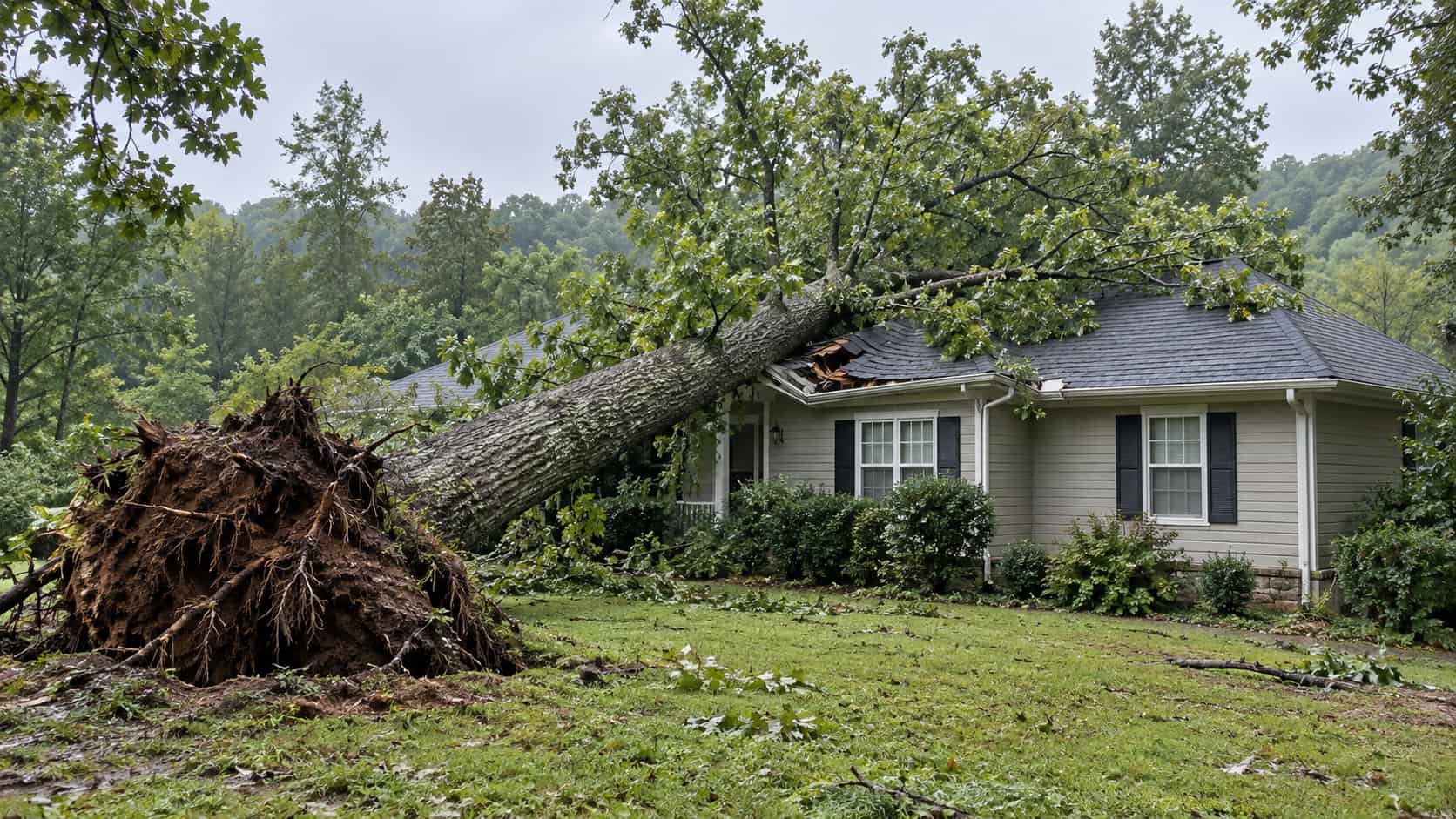
A tree on the house is frightening and the cleanup is where people get hurt. A calm sequence for the first hour, power lines, photos, insurance, and emergency removal.
A tree on the house is loud, frightening, and then strangely quiet. In the minutes afterward, most people want to do something, and the most useful thing is usually to slow down. The tree has already done what it is going to do. What matters now is that nobody gets hurt in the cleanup and that the next few days go as smoothly as they can.
This is the sequence we suggest to homeowners across Northeast Georgia and the Carolina foothills, where summer storms, saturated soil, and tall pines and oaks make this a call we take every year.
Before anything else, account for everyone in the house, including pets. If the tree came through the roof or a wall, leave that part of the house and stay out of it. Ceilings, attic framing, and trusses can shift after the initial impact, sometimes hours later, especially if it is still raining and the broken roof is taking on water.
If you smell gas, leave the house entirely and call your gas provider from outside. If you see sparks, smell burning, or the lights are flickering, turn off the main breaker if you can reach it safely and get out.
Do not go up on the roof. Do not go under the tree to see how bad it is. The pictures can wait.
Look at the tree from a distance and see whether any part of it is touching or lying across a power line, a service drop to the house, or the meter. Downed lines are not always obvious after dark or in heavy rain, and a line does not have to be sparking to be energized.
Georgia Power’s power line safety guidance puts it simply: always assume a downed line is live. Keep people and pets away, do not try to move a limb off a line, and call the utility or 911 to have it barricaded. Electric cooperatives across the region have the same rules and their own outage numbers, so it helps to keep yours saved in your phone before storm season.
Tree crews cannot work on a tree that is in contact with an energized line. The utility has to clear or de-energize the line first. If you call us and a line is involved, that is the first thing we will ask, and it is the first thing we will tell you to do.
Once people and lines are handled, take photographs. Wide shots of the whole scene from several angles, then closer shots of the roof, walls, gutters, vehicles, fences, and anything else the tree touched. If you can safely photograph the inside of affected rooms, do that too. Note the time.
These photos will matter for your insurance claim and, in some cases, for the tree service estimate. They are also the only record of the scene before anyone starts cutting.
The Insurance Information Institute’s overview of tree damage coverage explains the general pattern. A standard homeowners policy typically covers damage to your house and other insured structures when a tree falls on them, whether the tree was yours or a neighbor’s, along with some cost for removing the tree from the structure. If a tree falls in the yard and hits nothing, removal is often not covered. Every policy is different, so the specifics are between you and your agent.
Calling early does two things. It starts the claim and gets an adjuster scheduled, and it lets your insurer tell you what they need documented before the tree comes off the house. Most insurers want you to prevent further damage, which usually means getting the tree off and the roof tarped promptly, and they will reimburse reasonable costs for that. Keep every receipt.
If it was a neighbor’s tree, your own insurer is still the one to call. Your insurer may pursue the neighbor’s policy afterward if the tree was known to be dead or hazardous, but that is their process, not yours.
Removing a tree from a house is not the same job as removing a standing tree. The tree is under tension in ways that are hard to see, part of it is resting on a structure that is already damaged, and a wrong cut can drop weight onto the roof or shift the trunk into a wall. The work is planned in reverse: figure out where every section will go before anything is cut, then lift or lower pieces off the house rather than dropping them.
On many homes this means crane and rigging work, where sections of the tree are lifted straight up and away instead of rolled across the roof. On steep lots, tight lots, or where the tree is tangled in others, rigging from adjacent trees does the same job more slowly.
McAllister’s 24/7 emergency tree service is for exactly this situation: a tree on a structure, a tree blocking the only access to a property, or a tree that is actively failing over something important. The first goal is to make the site safe and stop further damage. Full cleanup and hauling can follow once the emergency is over, and after a widespread storm it often does, because every crew in the region is triaging.
When you call, the useful things to tell us are whether anyone is hurt, whether power lines are involved, where the tree is resting, what kind of access the property has, and whether you have photos to send.
Get the roof covered. A tarp secured properly over the damaged area keeps rain out until a roofer can make repairs. This is a job for a roofer or a contractor, not a ladder and a box of nails in the rain.
Then look at what is left standing. A tree that fell often had neighbors that grew up beside it and are now more exposed to wind. Trees that partially failed, lost a major limb, or shifted at the root plate may look fine from the ground and still be unstable. An arborist assessment after a storm is the way to sort out what else on the property needs attention before the next one.
The tree itself may not be a total loss either. Sound hardwood from a storm removal can sometimes be milled or cut for firewood rather than chipped, which is something to ask about once the emergency is handled.
A tree that fell across the back of the lot, dropped a limb on the lawn, or came down on a fence without touching the house is a cleanup job, not an emergency. It is still worth handling promptly, particularly if the root plate lifted and the hole is near a walkway, but it does not need a middle-of-the-night call. Storm damage cleanup covers that kind of work and can be scheduled once the urgent calls are done.
If a tree is on your house right now, call (706) 778-7527. If you are reading this ahead of time, save the number, save your utility’s outage line, and take a walk around the yard on the next calm day to see which trees could reach the house.
